

A loyalty campaign beats its redemption target. The team celebrates because members used the offer, revenue followed, and the segment looks valuable. Finance asks the harder question: did the offer increase long-term value, or did it subsidize customers who were already going to buy?
Share: Loyalty offer redemption is not the same as customer lifetime value. Identity, prior loyalty, margin, personalization, churn, basket expansion, and reward liability all matter. #Causality #RetailAnalytics #Loyalty
Synthetic teaching model
This article uses a synthetic retail model. It is not pricing, legal, financial, operational, compliance, or merchandising advice. The sources below justify why some variables belong in the model. The probabilities are invented so the reasoning path is easy to inspect.
The Operating Problem Is Usually Wider Than The Metric
Loyalty programs are built on customer history, but history can confuse the causal story. Frequent buyers are more likely to redeem because they already buy. Generous offers can lift activity and reward liability at the same time. A program can look successful in redemption while overstating customer lifetime value.
Why The Dashboard Can Mislead
The dashboard can mislead because redemption is easier to measure than incrementality. A high redemption rate may mean the offer was attractive, or it may mean the campaign selected people who were already highly likely to buy.
Plain-language modeling note
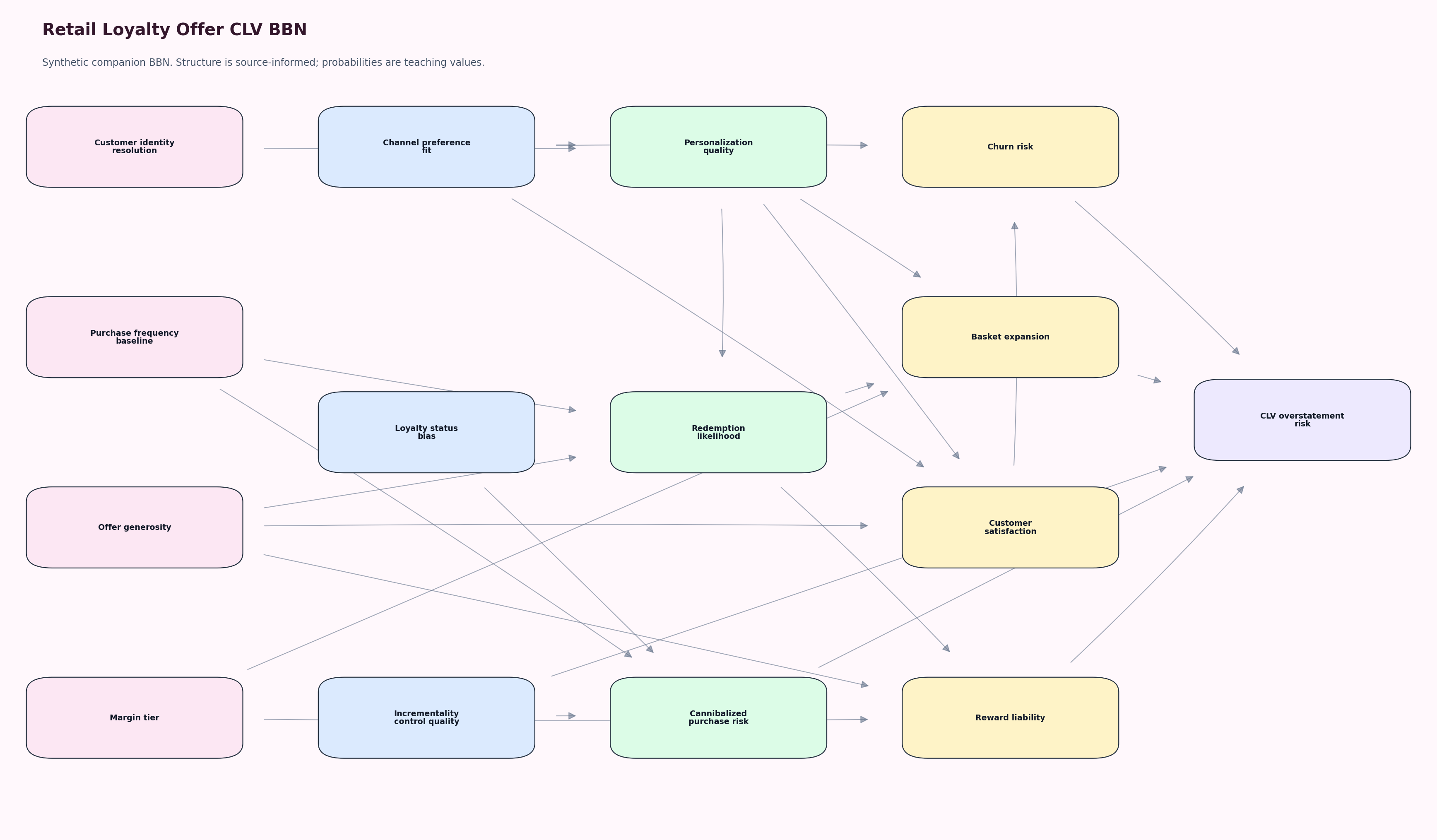
A Bayesian belief network, or BBN, is a graph for asking conditional questions. Each node is a condition, each arrow says one condition informs another, and each probability is explicit. You do not need to know the SDK to read the graph: the SDK code is only there when we need a repeatable action query.
The Question For This Example
This example asks how CLV-overstatement risk changes after observing high baseline purchase frequency, high offer generosity, poor incrementality controls, and low margin tier, and what changes if measurement improves, personalization improves, and generosity is reduced.
The target outcome is CLVOverstatementRisk, which means CLV overstatement risk in this teaching model.
A Small Model Of The Situation
The model treats a loyalty offer as a decision involving identity, prior loyalty, personalization, incrementality, margin, satisfaction, churn, and reward liability. It leaves out full CLV models, privacy policy, accounting treatment, expiration rules, and individual customer histories.
The graph has 15 nodes:
CustomerIdentityResolution: Customer identity resolution (good / poor)PurchaseFrequencyBaseline: Purchase frequency baseline (low / high)OfferGenerosity: Offer generosity (low / high)MarginTier: Margin tier (adequate / low)ChannelPreferenceFit: Channel preference fit (good / poor)LoyaltyStatusBias: Loyalty status bias (low / high)IncrementalityControlQuality: Incrementality control quality (good / poor)PersonalizationQuality: Personalization quality (good / poor)RedemptionLikelihood: Redemption likelihood (adequate / low)CannibalizedPurchaseRisk: Cannibalized purchase risk (low / high)ChurnRisk: Churn risk (low / high)BasketExpansion: Basket expansion (adequate / low)CustomerSatisfaction: Customer satisfaction (adequate / low)RewardLiability: Reward liability (low / high)CLVOverstatementRisk: CLV overstatement risk (no / yes)
What Is Sourced And What Is Synthetic
McKinsey’s CLV discussion supports identity resolution, cross-channel data, customer value, and continuous measurement. McKinsey’s personalization work supports relevance and tailored offers. Deloitte’s retail outlook supports loyalty programs, personalization, value-seeking consumers, and profitable transactions.
Customer lifetime value- McKinsey frames CLV around data collection, identity across channels, customer value, and targeted investments.
Personalized offers- McKinsey’s personalization work supports including message relevance, timing, and tailored offers as mechanisms.
Loyalty and profitable transactions- Deloitte’s outlook supports including loyalty programs, personalization, tiering, co-branding, and value-seeking customers.
Boundary of the evidence
The sources support the general mechanisms in the graph. They do not estimate this article’s node states, thresholds, or conditional probability values. Those are synthetic teaching values.
The Query The Graph Cannot Show By Itself
The visual graph is the best way to inspect the structure. The code-backed query is there for a narrower reason: we want to separate what is learned by observing a messy retail case from what changes if one condition is set differently.
Using the Darkstar Python SDK, a subscribed SDK user can load the same BBN JSON, ask for the target probability after evidence is entered, then run the action query by setting a node before querying again. The download includes this as illustrative SDK code, while the standalone query_example.py reproduces the article numbers without shipping the SDK.
import json

from darkstar import DiscreteModel

TARGET = "CLVOverstatementRisk"
OBSERVED_EVIDENCE = {
    "PurchaseFrequencyBaseline": "high",
    "OfferGenerosity": "high",
    "IncrementalityControlQuality": "poor",
    "MarginTier": "low"
}
INTERVENTION_CONTEXT = {
    "PurchaseFrequencyBaseline": "high",
    "MarginTier": "low"
}
INTERVENTION = {
    "IncrementalityControlQuality": "good",
    "PersonalizationQuality": "good",
    "OfferGenerosity": "low"
}


def probability_after_observing(model, evidence):
    query = {"nodes": [TARGET], "evidence": evidence}
    result = json.loads(model.pquery(json.dumps(query)))
    return result[TARGET]["yes"]


def probability_after_setting(model, setting, evidence):
    changed_model = model.intervene(json.dumps(setting))
    return probability_after_observing(changed_model, evidence)


with DiscreteModel(model_json) as model:
    observed = probability_after_observing(model, OBSERVED_EVIDENCE)
    acted = probability_after_setting(model, INTERVENTION, INTERVENTION_CONTEXT)
That is the article’s main modeling distinction. Observing a pattern is not the same as setting one part of the system differently.
The standalone query code gives this synthetic result:
Baseline CLV overstatement risk: 26.6%
Observed scenario (generous offer to already frequent low-margin buyers): 45.1%
Action scenario (measured, personalized, less generous offer): 23.3%
Same context with the action left unfavorable: 47.9%
Synthetic reduction versus the observed scenario: 21.8 percentage points
What We Learn By Observing The Situation
The observed scenario sets:
- Purchase frequency baseline = high
- Offer generosity = high
- Incrementality control quality = poor
- Margin tier = low
The observed scenario raises CLV-overstatement risk because the offer is generous, the buyers are already frequent, incrementality control is poor, and margin tier is low. The graph treats that as a classic case where activity can be mistaken for value creation.

What Changes If We Set One Condition Differently
The action scenario sets:
- Incrementality control quality = good
- Personalization quality = good
- Offer generosity = low
The action query improves incrementality controls and personalization while reducing offer generosity. It does not assume customers become more loyal. It asks whether the program’s value claim becomes more credible when the offer is better targeted and less purely subsidizing.
What This Example Cannot Prove
This model cannot calculate customer lifetime value, set a loyalty policy, or identify real customers. It is a teaching graph for why loyalty decisions need counterfactual thinking.
Try this in the shared model
Open the companion model, change one upstream condition at a time, and watch the target probability move. Start with the observed scenario above, then reset one condition that looks actionable. The point is to compare stories, not to treat the toy probabilities as a forecast.
Try The Model
Open the companion Darkstar model: Open Retail Loyalty Offer CLV BBN
In the shared model, keep OfferGenerosity high but set IncrementalityControlQuality good. Then keep measurement poor and improve personalization. The comparison separates measurement credibility from offer appeal.
Download the teaching package: Retail Loyalty Offer CLV BBN ZIP
The ZIP contains synthetic model and example code only. It excludes customer profiles, loyalty ledgers, transaction data, CLV models, SDK binaries, and chart-generation code.
Leave a Reply