
A retailer tightens its return policy after a costly season. The finance case is obvious: returns are expensive, abuse exists, and reverse logistics can erase margin. The customer case is also obvious: many shoppers buy online only because they trust the return path if fit, color, or quality disappoints.
Share: Returns policy design is a causal tradeoff. Free and easy returns can help conversion, but abuse risk, logistics cost, refund speed, and customer trust all move together. #Causality #RetailAnalytics #Returns
Synthetic teaching model
This article uses a synthetic retail model. It is not pricing, legal, financial, operational, compliance, or merchandising advice. The sources below justify why some variables belong in the model. The probabilities are invented so the reasoning path is easy to inspect.
The Operating Problem Is Usually Wider Than The Metric
Returns policy is not a single lever. A longer window may build confidence but invite abuse. A fee may reduce low-value returns but lower conversion. A slow refund may protect fraud review time but damage trust. The policy problem is finding the configuration that protects margin without teaching good customers to shop somewhere else.
Why The Dashboard Can Mislead
The dashboard can mislead if it reports return rate alone. A lower return rate may mean the policy deterred abuse, or it may mean shoppers stopped buying. A faster refund may please good customers, or it may leak fraud. The causal question is about the tradeoff, not a single count.
Plain-language modeling note
A Bayesian belief network, or BBN, is a graph for asking conditional questions. Each node is a condition, each arrow says one condition informs another, and each probability is explicit. You do not need to know the SDK to read the graph: the SDK code is only there when we need a repeatable action query.
The Question For This Example
This example asks how return-policy harm risk changes after observing a generous but expensive and weakly controlled return path, and what changes if fit information, fraud review, and refund speed are improved.
The target outcome is ReturnPolicyHarm, which means return policy harm in this teaching model.
A Small Model Of The Situation
The model treats returns as a tradeoff between customer confidence, operational cost, abuse risk, and future purchase behavior. It leaves out product categories, legal return requirements, marketplace rules, carrier contracts, and real fraud scoring.
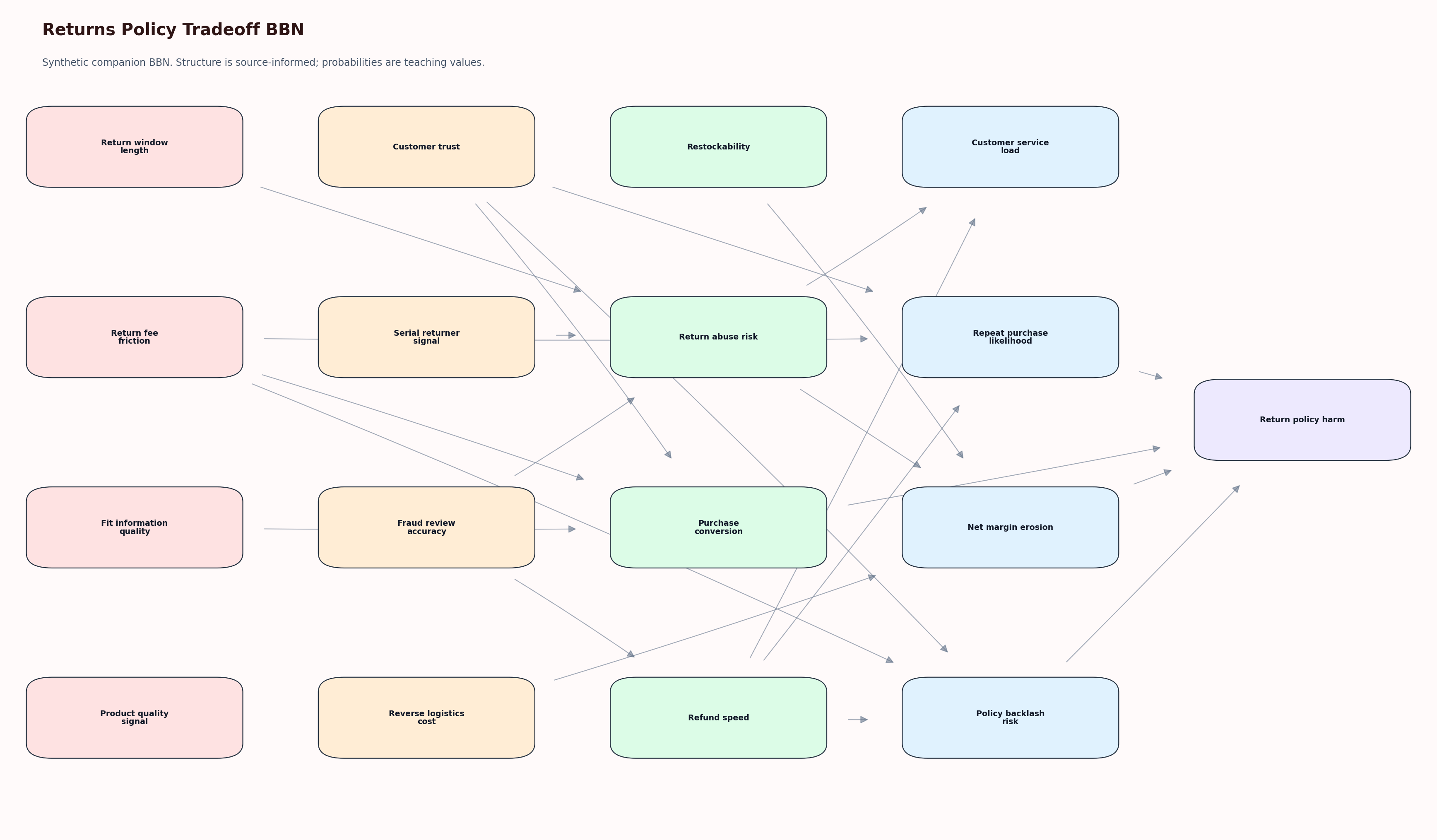
The graph has 17 nodes:
ReturnWindowLength: Return window length (short / long)ReturnFeeFriction: Return fee friction (low / high)FitInformationQuality: Fit information quality (good / poor)ProductQualitySignal: Product quality signal (good / poor)CustomerTrust: Customer trust (adequate / low)SerialReturnerSignal: Serial returner signal (low / high)FraudReviewAccuracy: Fraud review accuracy (good / poor)ReverseLogisticsCost: Reverse logistics cost (low / high)Restockability: Restockability (adequate / low)ReturnAbuseRisk: Return abuse risk (low / high)PurchaseConversion: Purchase conversion (adequate / low)RepeatPurchaseLikelihood: Repeat purchase likelihood (adequate / low)RefundSpeed: Refund speed (fast / slow)CustomerServiceLoad: Customer service load (low / high)NetMarginErosion: Net margin erosion (low / high)PolicyBacklashRisk: Policy backlash risk (low / high)ReturnPolicyHarm: Return policy harm (no / yes)
What Is Sourced And What Is Synthetic
NRF’s 2025 returns landscape supports the importance of returns, online return rates, free-return expectations, and fraud concern. Deloitte’s retail outlook supports the broader pressure around profitable omnichannel services. NRF AI materials support including fraud prevention and model accuracy as retail AI concerns.
Returns scale and fraud- NRF reports that returns are a large retail cost area and that fraud remains a concern, which motivates the abuse, logistics, and margin nodes.
Customer expectations- NRF’s returns research supports including free returns and confidence as shopping considerations.
Omnichannel profitability- Deloitte’s retail outlook motivates connecting returns policy to fulfillment cost, trust, and profitable omnichannel service.
Boundary of the evidence
The sources support the general mechanisms in the graph. They do not estimate this article’s node states, thresholds, or conditional probability values. Those are synthetic teaching values.
The Query The Graph Cannot Show By Itself
The visual graph is the best way to inspect the structure. The code-backed query is there for a narrower reason: we want to separate what is learned by observing a messy retail case from what changes if one condition is set differently.
Using the Darkstar Python SDK, a subscribed SDK user can load the same BBN JSON, ask for the target probability after evidence is entered, then run the action query by setting a node before querying again. The download includes this as illustrative SDK code, while the standalone query_example.py reproduces the article numbers without shipping the SDK.
import json

from darkstar import DiscreteModel

TARGET = "ReturnPolicyHarm"
OBSERVED_EVIDENCE = {
    "ReturnWindowLength": "long",
    "FraudReviewAccuracy": "poor",
    "ReverseLogisticsCost": "high",
    "CustomerTrust": "low"
}
INTERVENTION_CONTEXT = {
    "ReturnWindowLength": "long",
    "ReverseLogisticsCost": "high",
    "CustomerTrust": "low"
}
INTERVENTION = {
    "FitInformationQuality": "good",
    "FraudReviewAccuracy": "good",
    "RefundSpeed": "fast"
}


def probability_after_observing(model, evidence):
    query = {"nodes": [TARGET], "evidence": evidence}
    result = json.loads(model.pquery(json.dumps(query)))
    return result[TARGET]["yes"]


def probability_after_setting(model, setting, evidence):
    changed_model = model.intervene(json.dumps(setting))
    return probability_after_observing(changed_model, evidence)


with DiscreteModel(model_json) as model:
    observed = probability_after_observing(model, OBSERVED_EVIDENCE)
    acted = probability_after_setting(model, INTERVENTION, INTERVENTION_CONTEXT)
That is the article’s main modeling distinction. Observing a pattern is not the same as setting one part of the system differently.
The standalone query code gives this synthetic result:
Baseline return policy harm: 22.8%
Observed scenario (generous window with weak fraud review and high cost): 30.1%
Action scenario (better fit data, fraud review, and refund speed): 27.0%
Same context with the action left unfavorable: 36.1%
Synthetic reduction versus the observed scenario: 3.1 percentage points
What We Learn By Observing The Situation
The observed scenario sets:
- Return window length = long
- Fraud review accuracy = poor
- Reverse logistics cost = high
- Customer trust = low
The observed case sets a long return window, poor fraud review accuracy, high reverse-logistics cost, and low customer trust. The synthetic model treats that as a high-risk policy posture because both margin and retention are vulnerable.

What Changes If We Set One Condition Differently
The action scenario sets:
- Fit information quality = good
- Fraud review accuracy = good
- Refund speed = fast
The action query improves fit information, fraud review accuracy, and refund speed. That does not make returns free or abuse impossible. It asks whether a smarter policy path can reduce harm without relying only on more friction.
What This Example Cannot Prove
This model cannot write a returns policy, detect fraud, or estimate a retailer’s actual abuse rate. It is a teaching graph for why returns policy changes need both customer and cost paths.
Try this in the shared model
Open the companion model, change one upstream condition at a time, and watch the target probability move. Start with the observed scenario above, then reset one condition that looks actionable. The point is to compare stories, not to treat the toy probabilities as a forecast.
Try The Model
Open the companion Darkstar model: Open Returns Policy Tradeoff BBN
In the shared model, raise ReturnFeeFriction while keeping CustomerTrust low. Then improve FitInformationQuality instead. Compare which path moves the target through conversion versus margin.
Download the teaching package: Returns Policy Tradeoff BBN ZIP
The public ZIP contains the synthetic model and examples only. It excludes customer records, return histories, fraud signals, private policies, the SDK package, and chart-generation code.
Leave a Reply